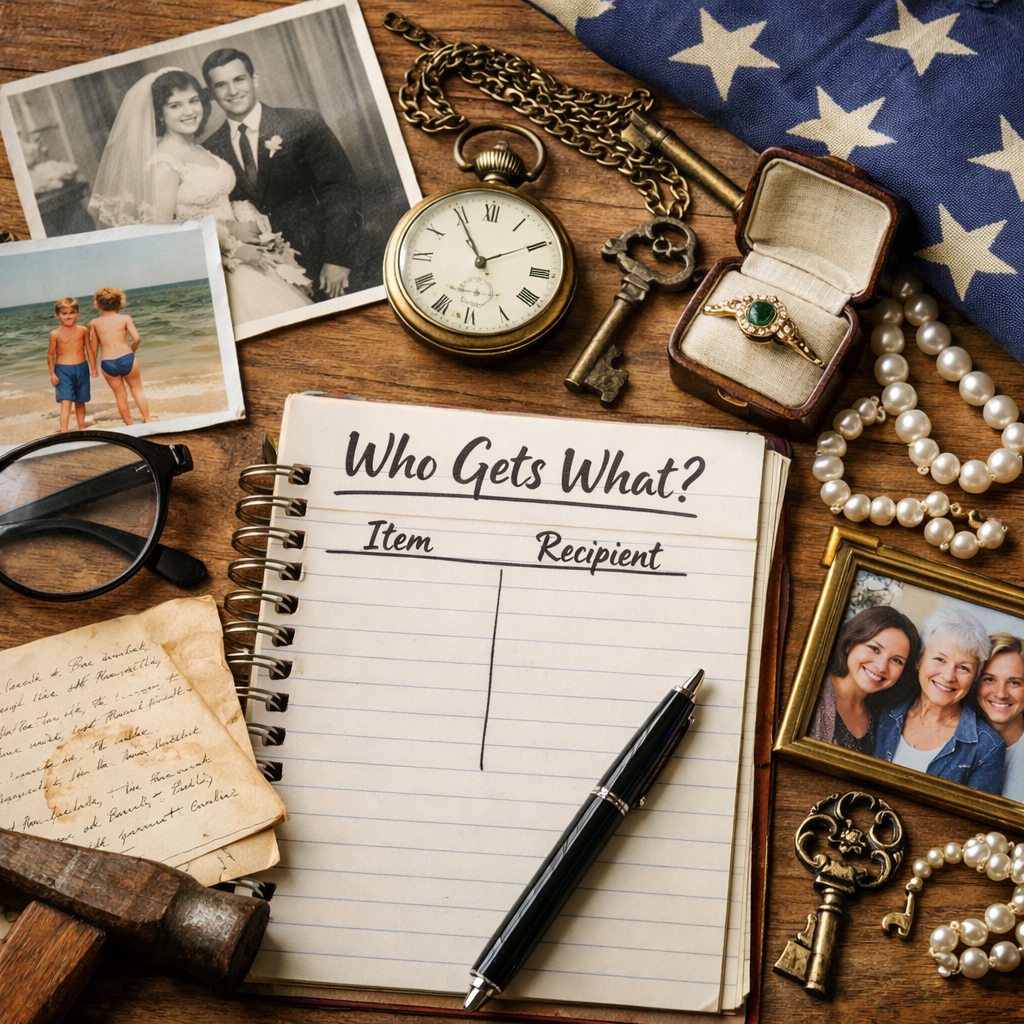
There is a quiet assumption most families make that causes more stress than almost anything else after a loss. It sounds like this: “They’ll know what I would have wanted.”
No. They won’t.
When it comes to physical photos, heirlooms, and sentimental items, people guess. And when people guess, emotions get involved. That is how families who love each other end up hurt, confused, or not speaking.
This is not about money. This is about meaning.
If you are in that 35 to 65 range, juggling kids, parents, work, and everything in between, this is one of those things that feels small right now but becomes very big later. Especially in blended families, chosen families, or situations where relationships are layered and not traditional.
Let’s talk about how to handle it in a way that is clear, practical, and actually helpful.
Why sentimental items cause the biggest problems
Your couch has a price tag. Your bank account has a balance. Your life insurance has a payout.
Your grandmother’s ring? Your wedding album? The box of letters in your closet? Those have stories, not price tags.
And here is the issue. Everyone attaches meaning differently.
One person sees a necklace. Another sees childhood. Another sees a promise. Another sees nothing at all.
So when no plan exists, people project their own meaning onto your things. That is where conflict starts.
Add in blended families, step relationships, or chosen family members, and now you have multiple perspectives, histories, and expectations in the same room.
This is not about fairness. It is about clarity.
Photos are a bigger deal than you think
Digital is easy to duplicate. Physical is not.
Those old photo albums, loose prints, framed pictures, and boxes in the closet are often one of a kind. Once they are divided or lost, they are gone.
If you have physical photos, ask yourself:
Who would want these
Who would actually take care of them
Should they be split, copied, or kept together
Is there someone outside of your biological family who should receive them
You may assume your kids will sort it out. In reality, they are grieving and overwhelmed. This becomes one more thing they have to figure out without guidance.
Write it down.
Heirlooms are not always what you think they are
When people hear heirloom, they think jewelry or antiques.
In real life, it looks more like:
Your dad’s tools
A recipe box
Holiday decorations
A piece of furniture
A watch that may or may not be worth anything
A random item that only makes sense to one person
The value is emotional, not financial.
That means your instructions matter more than ever.
Without them, people either argue, avoid the conversation completely, or make decisions they later regret.
Blended and chosen families need even more clarity
If your family does not follow a traditional structure, you cannot rely on default assumptions.
Stepchildren, longtime partners, close friends, caregivers, and chosen family members often get overlooked when nothing is written down.
Not because people do not care. Because legally and practically, no one knows what you intended.
If there are specific people you want to receive specific items, say it clearly.
Name them. Describe the item. Put it in writing.
This is one of the simplest ways to avoid hurt feelings later.
How to document your wishes the right way
You do not need a complicated system. You need a clear one.
Start with this:
Make a list of sentimental items
Be specific. “Mom’s blue vase from the dining room” is better than “vase.”
Assign each item to a person
Use full names. No guessing.
Add context if it matters
If there is a story or reason, include it. This can actually bring comfort later.
Keep it with your organized documents
If it is floating around in a drawer, it will not be found when it matters.
Update it when life changes
Relationships change. Your list should too.
Important note. This type of list is generally considered a personal planning tool and may not be legally binding unless properly referenced in a will. That is okay. The goal here is guidance and clarity so your people are not left guessing.
This is where most people get stuck
They think they need to do everything at once.
So they do nothing.
You do not need perfection. You need progress.
Even a simple list is better than silence.
Even a few clearly assigned items reduce stress.
Even one conversation makes a difference.
And if you are being honest, you already know exactly who you want certain things to go to. You just have not written it down yet.
This is one of those quiet responsibilities that only becomes urgent when it is too late.
Make it easier on your people
This is exactly why I built the system I use with clients.
At Life: Sorted, we help you take all of this, your documents, your accounts, your wishes, and yes, your sentimental items, and organize it into one clear, usable system.
Not a pile of papers. Not a guessing game.
A binder that answers questions before they become problems.
If you want to do it yourself, I have digital tools that walk you through it step by step.
If you want help, I work with clients to get it done in a way that is organized, clear, and actually usable when it matters.
You can start here: lifesorted.llc
Or call or text: 321-244-8885
Do not leave your people sorting through memories and emotions at the same time without direction.
They deserve better than that.
Disclaimer:
This content is for educational and informational purposes only. Life: Sorted is not a law firm and does not provide legal advice. Document preparation services are limited to clerical assistance. For legal guidance, consult a qualified attorney in your state.
Leave a Reply