You gave your spouse the password to your phone.
Your daughter knows where you keep the important papers.
Your son knows the PIN to your debit card.
So everyone is covered if something happens to you, right?
Not necessarily.
This is one of those areas of planning where what feels logical and what actually works in an emergency can be two very different things.
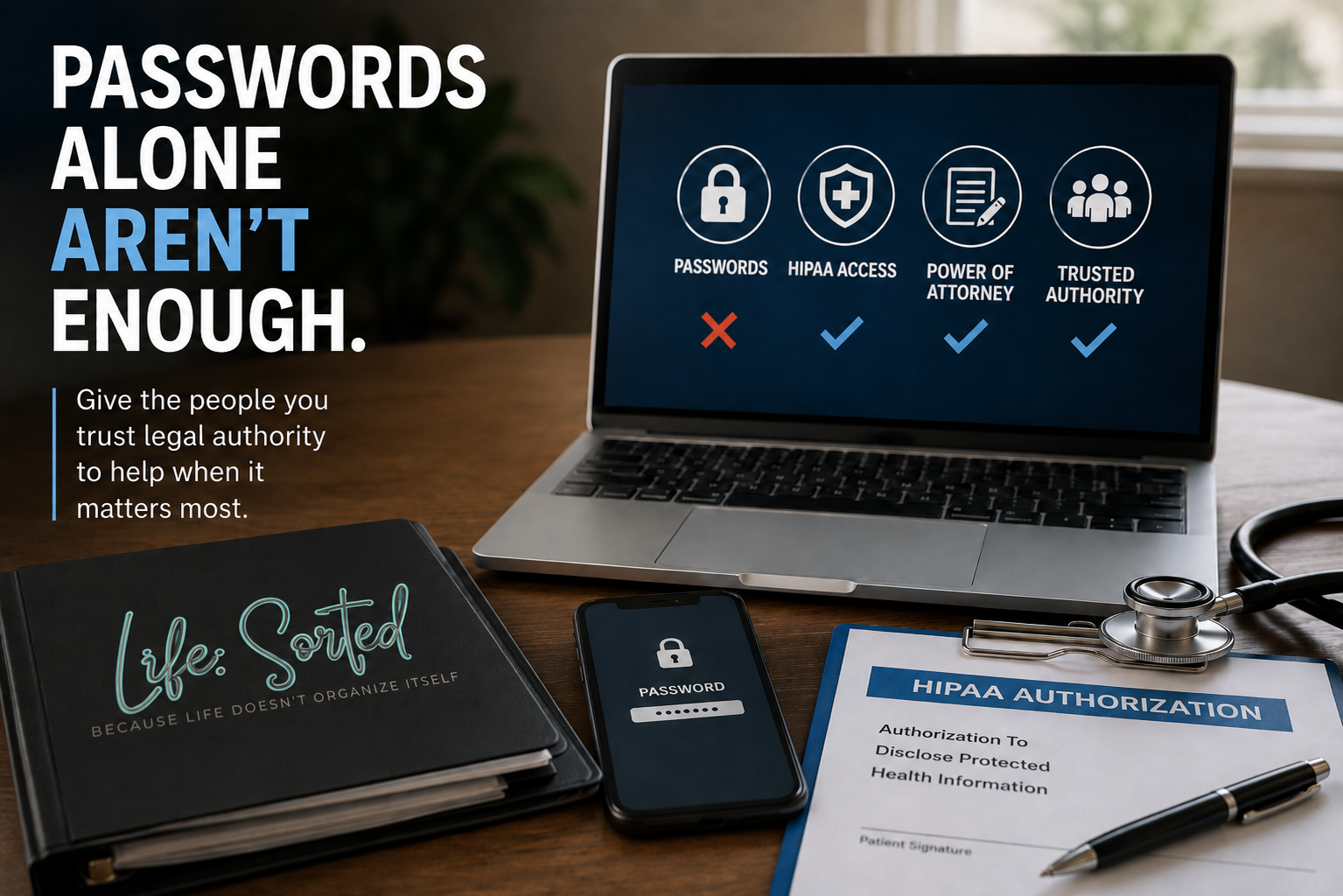
Passwords may help someone get through a login screen. They do not automatically give that person legal authority to act for you.
And when you are already juggling your own life, aging parents, adult children, work, appointments, prescriptions, insurance companies, and approximately 47 passwords you swear you will remember, this is not a technicality you want your family discovering during a crisis.
Knowing the Password Is Not the Same as Having Authority
We tend to think of access as practical.
If my husband knows the password, he can handle it.
If my daughter knows my doctor’s name, she can call.
If my son can unlock my phone, he can find whatever the family needs.
Sometimes that works.
Sometimes the answer on the other end of the phone is:
“I’m sorry. I’m not authorized to discuss that with you.”
That is the moment families discover there is a difference between knowing information and having permission to use it.
Banks, medical providers, insurance companies, financial institutions, online platforms, and other organizations have their own privacy and security obligations.
They generally cannot throw those rules out the window because the person calling sounds trustworthy and says, “But I’m her daughter.”
Turns out “I’m the daughter” is not a universally recognized legal document.
HIPAA Can Affect What Your Family Is Allowed to Know
HIPAA protects the privacy of your health information.
That protection is important.
But it can also be frustrating when someone you trust is trying to help you and has not been properly authorized.
Under federal HIPAA rules, a legally recognized personal representative can generally exercise certain rights on behalf of the patient, including access to protected health information to the extent that the representative’s authority applies.
Florida law also recognizes health care surrogates and provides a framework for someone to receive health information and make health care decisions when properly authorized.
This matters long before end-of-life care.
Imagine that you are temporarily unable to communicate after surgery.
Or you have a medical emergency while traveling.
Or one of your parents has a stroke and you are trying to coordinate medications, specialists, rehabilitation, and insurance.
Those are not moments when you want to begin figuring out who is legally permitted to receive information.
A HIPAA Authorization and a Health Care Surrogate Do Different Jobs
This is where people understandably get confused.
A HIPAA authorization can give specified people permission to receive certain protected medical information.
A Designation of Health Care Surrogate identifies the person you want involved in health care decisions and can address access to health information.
They are related, but they are not simply interchangeable pieces of paper.
Your goal should be to create a coordinated plan so the person you expect to help you actually has the authority and information needed to do the job.
Because saying, “My husband knows what I want” is wonderful from a relationship standpoint.
Administratively, it leaves something to be desired.
Then There Is the Durable Power of Attorney
Your Durable Power of Attorney addresses another part of the puzzle.
In Florida, a properly executed durable Power of Attorney can allow the person you designate, called your agent, to exercise the authority granted in the document even if you later become incapacitated.
Depending on the authority contained in the document, that may involve matters such as finances, property, accounts, bills, insurance, or other transactions.
This can become enormously important if you are alive but unable to manage things yourself.
The mortgage is still due.
The electric company would still like to be paid.
Insurance paperwork does not magically disappear because you are in the hospital.
Apparently, billing departments are remarkably resilient during family emergencies.
Having the appropriate documents in place helps your chosen person step into the administrative mess with actual authority instead of trying to piece everything together while simultaneously worrying about you.
But a Power of Attorney Stops at Death
This distinction is incredibly important.
In Florida, a Power of Attorney terminates when the person who created it dies.
That means your agent cannot simply continue using your POA indefinitely after your death.
After death, authority over estate matters generally shifts to the person legally authorized to administer the estate and depends on the type of asset, account ownership, beneficiary designations, probate requirements, and other circumstances.
This is exactly why good planning is bigger than having one document in a drawer.
You need to think about two different situations:
What happens if I am alive but cannot handle things myself?
And:
What happens after I die?
Those are not the same legal situation.
Your Digital Life Needs Its Own Plan
Now add another layer.
Your email.
Phone.
Cloud storage.
Social media.
Online banking.
Utilities.
Streaming accounts.
Photo libraries.
Subscriptions.
Medical portals.
Password manager.
Two-factor authentication.
And the random account you opened in 2017 that is apparently still charging you $8.99 every month.
Modern life has created an enormous digital footprint.
A good organizational plan should include an inventory of important accounts, instructions for finding them, information about where credentials are securely stored, and identification of the people who will need to handle things.
But simply writing every password on a sheet of paper is not an estate plan.
Different companies have different procedures for incapacitated or deceased users, and access to an account can involve privacy laws, contracts, ownership questions, security procedures, and other legal considerations.
Your organizational system should help your family know what exists and where to begin.
Your legal documents should address who has authority.
The two need to work together.
This Is Especially Important for the Sandwich Generation
If you are somewhere between approximately 35 and 65, there is a decent chance you are already managing more than one generation.
You may be helping your parents with medical appointments while still helping your kids figure out health insurance.
You may know your mother’s medications, your father’s Medicare information, your son’s college login, your spouse’s work schedule, and somehow still be expected to remember your own dentist appointment.
Welcome to the sandwich generation.
Here is the part we often miss:
While we are busy preparing to help everyone else, we rarely stop to make sure someone could help us.
If something happened to you tomorrow, would your spouse or adult child know:
Where your important documents are?
Who your doctors are?
What medications you take?
Where your insurance information is stored?
How your household bills are paid?
What accounts exist?
Where passwords are securely stored?
Who you have legally authorized to receive medical information?
Who can make health care decisions if needed?
Who can manage financial matters if you cannot?
That is the real test of whether your planning is finished.
Do Not Make Your Family Become Detectives
One of the greatest gifts you can give your family is clarity.
Not perfection.
Not a 200-page binder nobody is ever allowed to touch.
Clarity.
Here is what exists.
Here is where it is.
Here is who I chose.
Here is who can legally act.
Here is what I want.
Here is who to call.
Because when families do not have those answers, they become investigators during one of the most stressful periods of their lives.
They search filing cabinets.
They dig through email.
They guess passwords.
They call doctors.
They look through stacks of mail.
They try to determine which bills are automatic.
And occasionally they discover that Mom’s brilliant filing system consisted of three reusable grocery bags and a drawer labeled “important.”
You can do better than that for the people you love.
Do This While You Can Participate in the Decision
There is another reason not to keep pushing this down the list.
Planning is easiest when you can choose.
You can decide who you trust.
You can organize your information.
You can ask questions.
You can communicate your wishes.
You can make sure the people you name understand what you are asking them to do.
Waiting until there is a medical diagnosis, hospitalization, cognitive decline, or family emergency can make everything more complicated.
This is not about expecting something terrible to happen.
It is about accepting that at some point, almost every family needs someone else to step in and help.
Planning ahead lets you decide what that looks like.
Start With an Access Audit
You do not have to organize your entire life this afternoon.
Start with these questions:
Who would need to step in if I were hospitalized tomorrow?
Have I legally authorized that person where appropriate?
Can they obtain the medical information they would need?
Do I have a Durable Power of Attorney in place?
Do I have appropriate health care directives?
Does my trusted person know where those documents are?
Have I created an organized list of important accounts and digital assets?
Is there a secure way for the appropriate person to find passwords and authentication information?
Does my family know what should happen after my death instead of assuming the Power of Attorney continues?
If several of those answers are “I think so,” that is your sign to take another look.
“I think so” is not nearly as comforting at 2:00 a.m. in an emergency room as it sounds on a normal Tuesday afternoon.
Life: Sorted Can Help You Get the Pieces Organized
At Life: Sorted, the goal is not to scare people into planning.
It is to make planning understandable enough that you actually finish it.
I help individuals and families organize the information their loved ones would need, understand the purpose of common planning documents, identify gaps in their existing plan, and prepare permitted legal forms and documents within the scope of Florida law.
That might mean getting your HIPAA authorization organized.
It might mean completing advance health care documents.
It might mean putting a Durable Power of Attorney in place using the appropriate process.
Or it may simply mean creating one organized system so your family is not searching through your kitchen junk drawer looking for your life insurance policy.
You can learn more about Life: Sorted services at lifesorted.llc or call 321-244-8885.
You do not have to finish everything today.
But you should start while the choices are still yours to make.
Your family already has enough to deal with when something happens.
Finding the paperwork should not be one of those things.
Disclaimer
Life: Sorted, LLC is not a law firm and does not provide legal advice or representation. Information provided is for general educational purposes only. Legal document preparation services are limited to those permitted for nonlawyers under Florida law. Individuals with complex estates, trusts, tax concerns, contested family matters, Medicaid planning needs, or questions requiring legal advice should consult a qualified Florida attorney.
Leave a Reply